Article cover
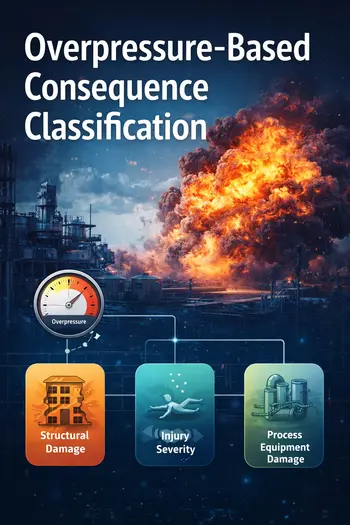
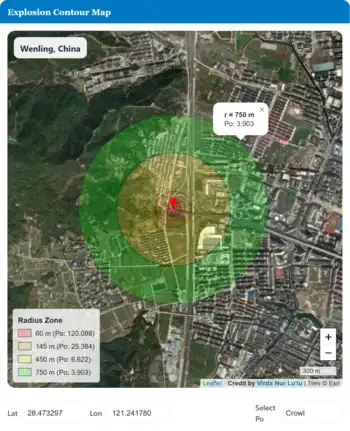
Overpressure contour
Abstract
Blast overpressure is one of the most widely used consequence indicators in explosion analysis because it provides a practical bridge between charge size, separation distance, and observable damage. For engineering screening, however, raw overpressure values are less useful than an interpretable framework that translates pressure ranges into likely effects on structures, people, and process equipment. This article reformulates the supplementary threshold tables used in the Xplosion platform into an academic narrative and organizes the classification into three consequence domains: structural damage, injury severity, and process equipment damage. The framework is built around peak overpressure bands expressed in kilopascals and is intended for transparent first-pass interpretation of TNT-equivalent calculations, including hydrogen, LPG, and ammonium-nitrate scenarios. The structural table spans low-pressure glazing damage, progressive architectural deterioration, and near-total building collapse. The injury table distinguishes primary blast effects from secondary and tertiary mechanisms and is partly adapted from the threshold logic presented on the Xplosion site, where Jeremić and Bajić (2006) are cited as a reference anchor, while the present article adds cross-validation against dedicated blast-injury literature. The equipment table extends the interpretation toward industrial systems by showing how low-to-moderate pressure increments can already produce meaningful losses of containment through displaced vessels, broken piping, damaged control houses, or collapsing support frames.
To improve interpretive validity, the article links the threshold framework with published literature commonly used in blast consequence work, including Crowl and Louvar for damage exemplars, CCPS for process-safety interpretation, Wang et al. for structured consequence assessment, Jeremić and Bajić for TNT-equivalent threshold anchoring, and blast-injury references such as Richmond et al. and Denny et al. for tympanic membrane rupture and duration-sensitive primary blast injury. The article is also explicitly tied to the Xplosion computational workflow, in which user inputs are converted into material mass, released energy, TNT equivalent, scaled distance, and model-specific overpressure predictions before the final consequence classification layer is applied. The resulting classification is not presented as a deterministic predictor of exact damage. Instead, it is positioned as a screening-level model that supports hazard zoning, preliminary siting discussion, academic comparison of scenarios, and communication of consequence severity to non-specialist readers. This makes the framework suitable as a supplementary research output for web publication, provided that its assumptions and limitations remain explicit.
Introduction
In consequence analysis, peak blast overpressure is frequently used as the first indicator of explosion severity because it can be estimated rapidly from TNT-equivalent methods and then mapped to distance. Yet engineering decisions rarely depend on the pressure value alone. Practitioners need an interpretation layer that explains what a given pressure range means in practical terms: whether it is expected to shatter glazing, damage non-structural building components, rupture eardrums, create fragment hazards, deform support frames, or move process equipment off foundation.
The Xplosion threshold page addresses this need by arranging overpressure into three tables that classify consequences for building structures, exposed people, and process equipment. The present article preserves the same numerical bands used on the supplementary page but reframes them as an academic consequence-classification layer rather than as a stand-alone predictive model. The aim is to make the material citable, interpretable, and easier to defend in a research context.
Research position of the framework
This framework is designed for early-stage consequence screening. It is suitable for comparative studies, safe-distance discussion, educational use, and publication supplements that accompany TNT-equivalent calculations. It is not a replacement for detailed blast-structure interaction modelling, CFD-based vapor-cloud explosion analysis, or fragment-trajectory simulation.
Linkage to computational workflow
The consequence-classification tables are not independent of the simulation engine. Within the Xplosion platform, the workflow begins when the user selects the material, inventory volume, and evaluation distance. The platform then loads editable default properties such as density, explosion enthalpy, ambient pressure, explosion efficiency, and TNT energy.
These inputs are converted into the core computational variables used by the platform: material mass, released energy, TNT-equivalent mass, scaled distance, scaled overpressure, and model-specific peak overpressure. The overpressure is then estimated using the implemented Crowl, Alonso, and Sadovski correlations, after which the platform checks whether the computed scaled distance remains within the recommended validity range for each model.
The classification framework in this article operates at the final interpretation stage of that workflow. Once peak overpressure has been calculated, the Xplosion platform maps the result to structural-damage bands, injury-consequence bands, and process-equipment damage bands, and then uses the same result for graph plotting, node logging, and contour visualization. In this sense, the article should be read as the interpretive consequence layer of the Xplosion computational chain rather than as a separate empirical model.
User input → material properties → mass and released energy → TNT equivalent → scaled distance → overpressure by selected model → consequence classification.
Source basis and validation
The three threshold tables in this article originate from the Xplosion supplementary threshold page and related research materials. The structural and equipment examples are largely rooted in the threshold traditions reproduced in Crowl and Louvar, CCPS-based process-safety references, and related consequence-screening literature. The broader screening logic is also consistent with NOAA ALOHA, which uses representative default overpressure levels such as 1.0 psi for shattered glass, 3.5 psi for serious injury likely, and 8.0 psi for destruction of buildings.
The main refinement introduced here concerns the injury table. On the Xplosion threshold page, Table 2 cites Jeremić and Bajić (2006) as a reference anchor. In the present article, that threshold basis is retained as part of the supplementary framework, but the interpretation is additionally cross-validated against dedicated blast-injury literature. Richmond et al. summarized tympanic membrane rupture correlates and reported widely cited reference values such as a human eardrum rupture threshold around 35 kPa and a P50 near 100 kPa, while Denny et al. emphasized that clinically relevant primary blast injury must be interpreted together with positive-phase duration rather than peak pressure alone.
The framework is strong as a transparent screening aid because it preserves the same threshold logic across structures, people, and equipment while linking it to recognizable literature anchors.
Equipment and injury thresholds remain context dependent. Construction details, reflection, shielding, body orientation, wave duration, and connected piping geometry can shift real-world damage away from nominal threshold bands.
Threshold tables
Table 1. Classification of Structural Damage Based on Blast Overpressure
Adapted from the supplementary threshold framework for building-structure interpretation.
| Risk code | Band | Po (kPa) | Representative structural effects |
|---|---|---|---|
| RDS1 | Insignificant | 0.14–≤2 | Annoying noise, stressed glazing failure, small-window breakage, typical glass breakage near 1.03 kPa, and accidental glass damage. |
| RDS2 | Minor | >2–≤9 | Minor ceiling damage, 10% window breakage, limited minor house damage, partial house collapse at upper range, and light architectural damage such as falling plaster or displaced roof tiles. |
| RDS3 | Moderate | >9–≤25 | Partial roof and wall collapse, serious structural damage lower bound, 50% brick-wall collapse, distortion of steel frames, collapse of unreinforced concrete walls, and rupture of oil-storage tanks at upper range. |
| RDS4 | Serious | >25–≤40 | Collapse of light industrial structures, broken utility poles, damaged hydraulic equipment, extensive facade and ceiling damage, and near-total destruction of residential houses near the upper band. |
| RDS5 | Severe | >40–≤55 | Near-total residential destruction, ceiling collapse, and shear or bending failure of thick unreinforced brick panels. |
| RDS6 | Major | >55–≤76 | Freight train cars completely destroyed, continued failure of unreinforced brick panels, partial collapse of building elements, and significant damage to concrete columns. |
| RDS7 | Catastrophic | >76 | Likely total damage to structures, heavy equipment displacement, and near-total collapse including major damage to load-bearing concrete columns. |
Table 2. Classification of Injury Severity Based on Blast Overpressure
Partly adapted from the Xplosion threshold page and its Jeremić & Bajić (2006) citation basis, then cross-validated against dedicated blast-injury literature for interpretation.
| Risk band | Po (kPa) | Primary blast effects | Secondary / tertiary effects | Interpretive conclusion |
|---|---|---|---|---|
| Minor injury | <20 | No major primary blast injury expected; eardrum rupture generally not significant. | Glass cracking can start around the lower-kPa range, so fragment injury may still occur. | Direct physiological injury is limited, but secondary injury from fragments remains relevant. |
| Moderate injury | 20–30 | Minor contusion; low-probability eardrum rupture becomes plausible near this band. | Moderate structural damage can cause falling ceiling sections and small dropped objects. | Combined minor primary effects and debris-related injuries begin to matter operationally. |
| Serious injury | 30–50 | Moderate contusion; the band approaches commonly cited eardrum rupture thresholds. | Flying debris becomes more significant because structural disruption is broader. | Injury severity increases because primary and fragment mechanisms act together. |
| Severe injury | 50–100 | Serious internal contusion is possible; blast-lung risk becomes duration sensitive. | Heavy structural damage and rubble entrapment substantially raise fatal outcome potential. | Potentially fatal injury mechanisms are now concurrent rather than isolated. |
| Fatality | >100 | High mortality risk for unprotected persons, but exact lethality depends strongly on duration and reflection. | Total or near-total collapse and large debris motion dominate the environment. | This band should be interpreted as extreme life-safety threat rather than a single universal fatality cutoff. |
Table 3. Classification of Process Equipment Damage Based on Blast Overpressure
Industrial interpretation of how rising overpressure bands can escalate from instrumentation damage to loss of containment and vessel movement.
| Risk code | Band | Po (kPa) | Representative equipment effects |
|---|---|---|---|
| RDE1 | Insignificant | <3.45 | No significant process equipment damage recorded. |
| RDE2 | Minor | 3.45–<10.34 | Breakage of gauges and windows in control houses, cooling-tower louver loss, roof collapse in steel-roof control houses, switchgear damage, and cone-roof tank roof collapse. |
| RDE3 | Moderate | 10.34–<27.58 | Control-house frame deformation, cubicle damage, cooling-tower internal damage, heater brick cracking, connected-pipe failure, tilted tanks, severed power lines, and movement of process units with piping breakage. |
| RDE4 | Serious | 27.58–<41.37 | Reactor movement, broken connected piping, filter internal damage, damaged transformer casing, heater overturning, deformed structural frames, and cracked fractionation-column frame. |
| RDE5 | Severe | 41.37–<55.16 | Instrument cubicle overturning, collapse of pipe-support frames, deformation of horizontal pressure-vessel frames, large tank uplift and tilt, extraction-column movement, and broken process connections. |
| RDE6 | Major | 55.16–<82.74 | Spherical tank movement with broken pipes, overturning of chemical reactors and heat exchangers, heavy tilting of filters, blower failure, and extraction-column foundation shift. |
| RDE7 | Catastrophic | ≥82.74 | Overturning or destruction of filter, cracking reactor, extraction column, spherical tank, vertical pressure vessel, pump, and steam-turbine systems, accompanied by extensive connected-pipe failure. |
Interpretive discussion
1. Structural consequences are not linear
The structural table shows that very small pressure increments at the low end can already change the damage mode from acoustic nuisance to visible glazing failure. At higher bands, the dominant mechanism shifts from brittle facade damage toward partial collapse of walls, roofs, and ultimately load-bearing elements. This nonlinearity is why threshold-based communication is useful: the engineering meaning of 5 kPa and 50 kPa is not simply a tenfold change, but a qualitative transition in damage regime.
2. Injury interpretation must separate direct and indirect mechanisms
A recurring problem in blast communication is the assumption that one pressure value corresponds directly to one injury outcome. In reality, primary blast injury affects gas-containing organs, while secondary and tertiary injuries arise from fragments, collapse, and body displacement. The table therefore distinguishes direct physiological effects from structural-debris mechanisms. This distinction improves academic credibility because severe human harm can occur even where the pressure alone is below a universal fatality threshold.
3. Process equipment can become critical at moderate pressure
For industrial facilities, the equipment table highlights a practical point: meaningful escalation potential begins well before total destruction. Control houses, support frames, gauges, piping, and anchored units may fail in moderate bands, which can transform a single explosion into a multi-unit event through release, ignition, or systems loss.
Engineering application
In practice, the framework is used after a TNT-equivalent or empirical blast calculation has produced a side-on or incident overpressure at a given distance. The analyst can then classify that pressure simultaneously in three ways: likely building response, likely human exposure category, and likely process-equipment consequence. This tri-domain interpretation is particularly helpful for siting discussions involving control rooms, assembly points, occupied buildings, storage areas, and equipment clusters, and it corresponds directly to the final interpretation stage described in the Xplosion process-flow page.
The framework is also useful for academic comparison between materials or models. For example, two scenarios may produce different pressure-distance curves, but if both cross the same threshold band at a given location, their engineering implication may be similar from a zoning perspective. That makes the classification framework easier to communicate than raw pressure curves alone.
“The overpressure classification presented here is intended as a transparent screening framework for preliminary consequence interpretation. It does not substitute for detailed structural, biomedical, fragment, or CFD-based analyses when project-specific design decisions are required.”
Limitations
Several limitations should remain explicit. First, the framework is based on peak overpressure bands, while real damage can also depend on positive-phase duration, dynamic impulse, reflected pressure, confinement, and stand-off geometry. Second, the same overpressure may produce different damage in different buildings because facade systems, reinforcement, anchorage, and maintenance condition vary substantially. Third, process equipment vulnerability depends strongly on support details, nozzle loads, connected piping flexibility, corrosion condition, and operating pressure.
The injury bands are especially sensitive to interpretation. Eardrum rupture is sometimes used as a visible threshold marker, but it is not a surrogate for fatal injury, and fatal injury itself cannot be reduced to a single pressure cutoff without reference to duration and exposure configuration. Accordingly, the framework should be read as a conservative interpretive aid rather than a clinical model.
Conclusion
The consequence-classification framework presented in this article converts blast overpressure into an interpretable multi-domain screening layer covering structures, exposed people, and process equipment. Its main value lies in transparency. Instead of presenting pressure-distance results without context, the framework assigns each value to qualitative bands that can be discussed academically and applied consistently in early-stage hazard zoning.
With explicit workflow linkage, validation notes, and limitations, the framework is suitable as a supplementary publication layer for the Xplosion research platform. It is especially relevant for thesis dissemination because it connects numerical TNT-equivalent modelling with practical engineering interpretation while remaining explicit about uncertainty and screening scope.
References
Core technical references
- Wang, Q., Zhang, L., Wang, L., & Bu, L. (2023). A practical method for predicting and analyzing the consequences of ammonium nitrate explosion accidents adjacent to densely populated areas. Heliyon, 9(5), e15616. https://doi.org/10.1016/j.heliyon.2023.e15616
- Crowl, D. A., & Louvar, J. F. (2011). Chemical Process Safety: Fundamentals with Applications (3rd ed.). Prentice Hall.
- Center for Chemical Process Safety (CCPS). (2000). Guidelines for Chemical Process Quantitative Risk Analysis (2nd ed.). John Wiley & Sons.
- Jeremić, R., & Bajić, Z. (2006). An approach to determining the TNT equivalent of high explosives. Scientific Technical Review, 56(1), 58–62.
- Richmond, D. R., Yelverton, J. T., Fletcher, E. R., & Phillips, Y. Y. (1989). Physical correlates of eardrum rupture. Annals of Otology, Rhinology & Laryngology Supplement, 98(10 Suppl 140), 35–41. https://doi.org/10.1177/00034894890980S507
- Denny, J. W., Langdon, G. S., & Dickinson, A. S. (2023). Guidelines to inform the generation of clinically relevant and realistic blast loading conditions for primary blast injury research. BMJ Military Health, 169(4), 364–370.
- Dunjó, J., Amorós, M., Prophet, N., & Gorski, G. (2016). Risk-Based Approach – Damage Criteria: An Overview of State-of-the-Art Damage Criteria for People and Structures. ioMosaic White Paper.
- NOAA Office of Response and Restoration. (n.d.). Overpressure levels of concern. ALOHA documentation and hazard interpretation resource.
Supplementary Xplosion web sources
- Xplosion Research Archive. (2026). Xplosion: Simulation and Modeling Platform for TNT-Equivalent Explosion Consequences. https://xplosion.pages.dev/
- Xplosion Research Archive. (2026). Overpressure Thresholds Based on TNT Equivalent. https://xplosion.pages.dev/html/thresholds
- Xplosion Research Archive. (2026). Process Flow of TNT-Equivalent Explosion Simulation and Modeling. https://xplosion.pages.dev/html/flow-process
- Xplosion Research Archive. (2026). Comparative Simulation and Modeling of Hydrogen Explosion Consequences Based on TNT Equivalent. https://xplosion.pages.dev/articles/2026-01-h2-tnt-equivalent
- Xplosion Research Archive. (2026). Overpressure Thresholds Based on TNT Equivalent (PDF version). https://xplosion.pages.dev/pdf/Overpressure_thresholds_Based_on_TNT_equivalent.pdf